
Kiowa County Criminal Court Records
A criminal court record begins when a charge is filed with the court and the clerk opens or updates the case file. In Kiowa County, that court file can include the complaint or information, advisement entries, bond orders, pleas, motions, hearing settings, disposition, sentencing orders, fines, costs, restitution, probation terms, and warrants or revocation entries when those items are public. It is the case-level record, not just the arrest event.
Felony cases are district-court matters. Misdemeanors and many traffic misdemeanors are often handled in county court. Kiowa County uses Kiowa County Combined Court as the local Colorado Judicial Branch access point, while broader district functions fall within the 15th Judicial District. The District Attorney for the 15th Judicial District decides which formal charges to file after an arrest or summons, and public defender representation may appear on the docket when the defendant qualifies.
Search Kiowa County Criminal Case Files
Start with Colorado Judicial Branch dockets to identify hearing dates, case numbers, court level, hearing type, and public disposition clues. The docket is not a full criminal file, so use the Colorado Judicial record/document request form for a certified disposition, sentencing order, docket sheet, mittimus, or other public case document. If the question is about current custody, use sheriff channels or DOC search rather than the court docket alone.
- Select Kiowa County in the Colorado Judicial docket search.
- Use the case number if known, or search by hearing date and public party information when available.
- Confirm whether the matter is in county court or district court.
- Read the public events for advisement, arraignment, plea, motions, disposition, and sentencing entries.
- Request certified copies from Kiowa County Combined Court when a docket entry is not enough.
The CBI Internet Criminal History Check System is a separate statewide name-based criminal-history product. It can be useful for a broader Colorado criminal-history check, but it is not a substitute for the certified Kiowa County court disposition in a specific case.
The CBI Internet Criminal History Check System is the official state-level criminal history channel.
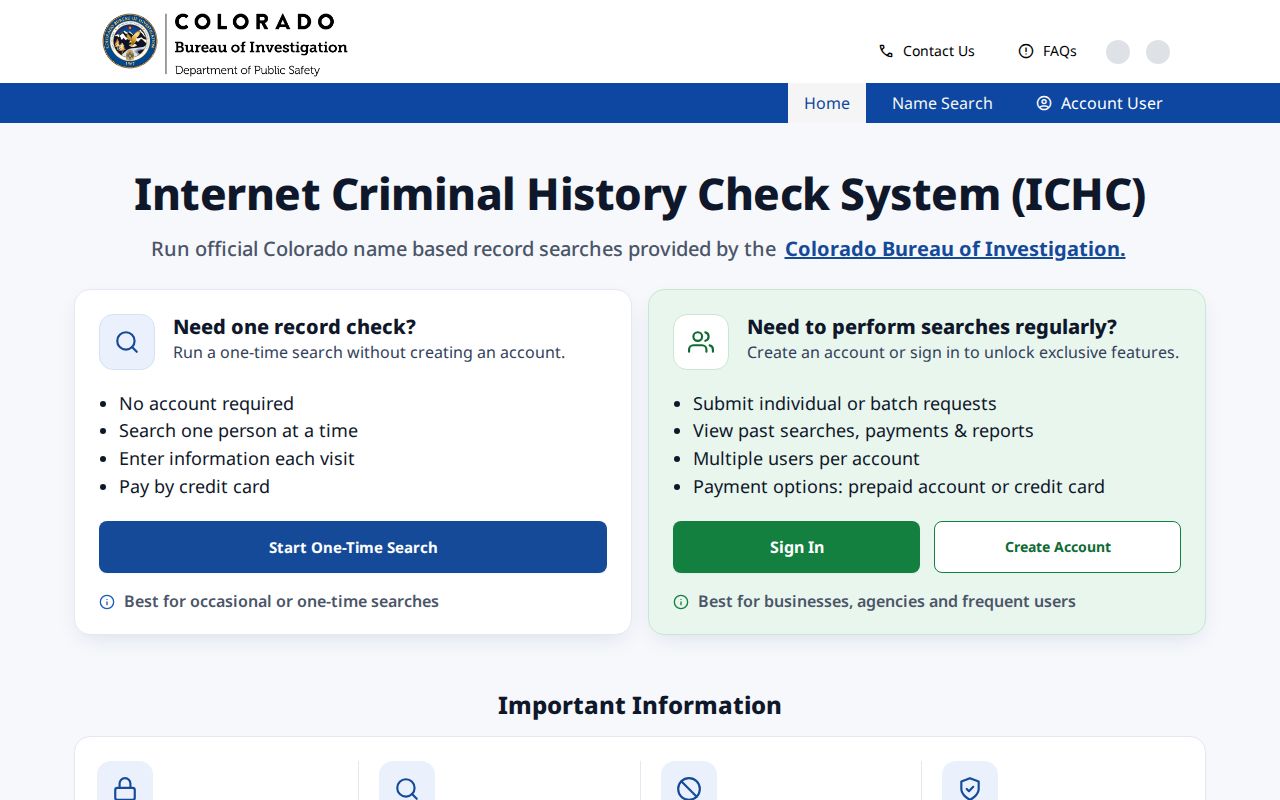
Use CBI for statewide criminal-history context, then return to the court clerk for case-specific records, dispositions, and sentencing documents.
Kiowa County Criminal Case Flow
A criminal case moves through court in stages, and each stage can leave a docket entry or filed document. The exact path depends on the charge, custody status, plea negotiations, motions, and whether the case is resolved by plea, dismissal, trial, deferred judgment, or sentencing. A single case may have several charges with different outcomes.
Case flow: Charges Filed › Arraignment › Pretrial / Motions › Plea or Trial › Disposition › Sentencing
| Stage | What Happens |
|---|---|
| Charges Filed | The prosecutor files a complaint, information, or other charging document with the court. |
| Arraignment / Advisement | The defendant is advised of rights and charges, and a plea may be entered or scheduled. |
| Pretrial / Motions | Attorneys address discovery, bond, suppression issues, continuances, or plea negotiations. |
| Plea or Trial | The case resolves by plea, trial verdict, dismissal, deferred judgment, or other court action. |
| Sentencing | The court imposes jail, DOC, probation, fines, costs, restitution, classes, or other lawful terms. |
What Kiowa County Criminal Records Show
Criminal court records should be read field by field. A charge on the docket is not always the final outcome. The disposition and sentence usually matter most when proving what happened. Bond, restitution, probation, and warrant entries may affect the case long after the first charge was filed. Redactions can limit public access to birth dates, protected addresses, minor information, victim details, and sealed material.
| Field | What It Shows |
|---|---|
| Case Number | Colorado criminal case identifier with year, case class, and sequence where public. |
| Defendant | Name or public caption, with protected details redacted where required. |
| Charges | Offense description, statute, severity level, and filed count information. |
| Plea | Guilty, not guilty, deferred, or other plea status entered in court. |
| Hearings | Advisement, arraignment, motions, status, trial setting, review, or sentencing events. |
| Disposition | Final result, such as guilty, dismissed, acquitted, deferred, or amended outcome. |
| Sentence | Jail, DOC, probation, fines, costs, restitution, treatment, classes, or other terms. |
| Warrant / Bond | Bond conditions, no-contact orders, bench warrants, revocations, or release terms when public. |
Charges vs Convictions
A filed charge is an accusation accepted into the court process. A conviction is a final finding or plea of guilt. Kiowa County criminal court records can show charges that were reduced, amended, dismissed, deferred, or resolved differently across separate counts. That is why the disposition line matters more than the first charge list when reading a criminal case file.
| Charge | Conviction | |
|---|---|---|
| Stage | Filed at or near the start of the court case | Entered after plea, verdict, or other final court action |
| Meaning | An allegation the prosecutor asks the court to process | A legal outcome showing guilt on a count |
| Record Use | Helps track what was alleged | Used to prove criminal case outcome |
| Risk | May remain visible even if later dismissed unless sealed | May affect sentence, probation, driver status, and criminal history |
Sealed vs Expunged Criminal Records
Colorado restricts juvenile, sealed, expunged, adoption, mental health, protected-party, and victim-sensitive records. Sealing hides a record from ordinary public access while allowing some government access under law. Expungement applies only in specific categories and may remove material more completely from public access. A Kiowa County case normally must be handled through the court that processed the case.
| Sealed | Expunged | |
|---|---|---|
| Public visibility | Hidden from ordinary public search | Removed from public access in eligible categories |
| Government access | Courts and law enforcement may retain limited access | Access is more limited and depends on statute |
| Common use | Adult cases when Colorado criteria and court orders allow | Juvenile and specific statutory categories |
| Starting point | Identify case number, disposition, fines, and restitution status | Confirm eligibility through Colorado law and court forms |
Access to Kiowa County Criminal Records
Adult criminal court dockets are generally public when not sealed or otherwise restricted, but court files are governed by judicial-branch access rules, redaction rules, and court orders. Colorado's Criminal Justice Records Act, CRS 24-72-301 et seq., also matters for law-enforcement and prosecution records. Juvenile confidentiality comes from CRS Title 19 and related court rules.
The safest public-record chain is docket first, clerk request second, CBI history only for statewide summary context, and sheriff contact for booking or live custody. Court charges after arrest are discussed more closely on the Kiowa County arrest records and court charges page, while all case types are covered in the broader Kiowa County court records page.
Restricted Kiowa County Criminal Records
Not every criminal-related record is public. Juvenile delinquency, certain victim information, protected addresses, sealed arrest or court records, mental health material, unexecuted search warrants, and active investigative details may be withheld. Some warrant-related details may be visible on a docket only after a court event, while live warrant status should be verified with the court or sheriff.
For sealing, first identify the exact case number and disposition from Kiowa County Combined Court. Then review Colorado Judicial Branch sealing materials, confirm eligibility, serve the required agencies if needed, and file in the court that handled the case. If a judge grants sealing, the order is distributed to named agencies. Sealing does not always erase every government record for every official purpose.
Note: A criminal court record can include dismissed charges, so read the disposition before treating a charge as an outcome.