
Kiowa County Arrest Records and Court Charges
An arrest record is created by law enforcement when a person is arrested or booked. It may include the arresting agency, booking date, charge held for booking, fingerprint and photo process, property inventory, bond or hold information, and release status. In Kiowa County, official research did not locate a public online jail roster or current booking list, so custody and booking questions should be directed to the Kiowa County Sheriff's Office rather than to an unofficial database.
A court charge record is different. It begins when the District Attorney for the 15th Judicial District decides what formal charges to file after an arrest, summons, or citation. Those court charges after arrest become part of the criminal case file once filed with Kiowa County Combined Court. For the full case file and final outcome, use Kiowa County criminal court records. For current custody or jail detail, use the inmate page and sheriff channels.
Find Kiowa County Arrest Records and Charges
The search path depends on the question. For live custody, booking, bond, or release status, contact the Kiowa County Sheriff's Office or the county sheriff page. For filed charges, court dates, pleas, and dispositions, use Colorado Judicial Branch dockets and then request documents through the court clerk. For statewide criminal-history context, use the CBI Internet Criminal History Check System.
- For custody status, ask the sheriff for the person's current location, booking date, held charges, bond, and release status.
- For filed charges, search Colorado Judicial dockets by Kiowa County, date, case number, or public party information.
- Review each count for offense description, statute, severity level, plea, status, and disposition if public.
- Request a docket sheet, charging document, disposition, or sentencing order from Kiowa County Combined Court if a formal copy is needed.
- Use CBI only as a statewide criminal-history product, not as a live warrant or jail database.
Charges After Arrest in Kiowa County
After an arrest or summons, the prosecutor reviews reports and decides whether to file charges, amend them, decline them, or pursue a different count than the booking allegation. The charging document controls the court case. It may list one count or many counts. A single arrest can result in several filed charges, and a filed charge can later be reduced, dismissed, amended, or resolved through plea or trial.
| Complaint | Information | Indictment | |
|---|---|---|---|
| Filed By | Officer or prosecutor depending on case path | Prosecutor | Grand jury |
| Common Use | Early or lower-level criminal filings | Many felony and formal prosecutor filings | Serious or grand-jury-reviewed matters |
| Record Role | States allegations accepted into court | Sets out formal counts for prosecution | Charges returned after grand jury action |
| Where It Appears | Criminal court file and docket references | Criminal court file and docket references | Criminal court file and docket references |
A federal prosecutor reference from the U.S. Attorney's Office for the District of Colorado helps separate federal cases from Kiowa County state charges handled through Colorado state court and the 15th Judicial District prosecutor path.
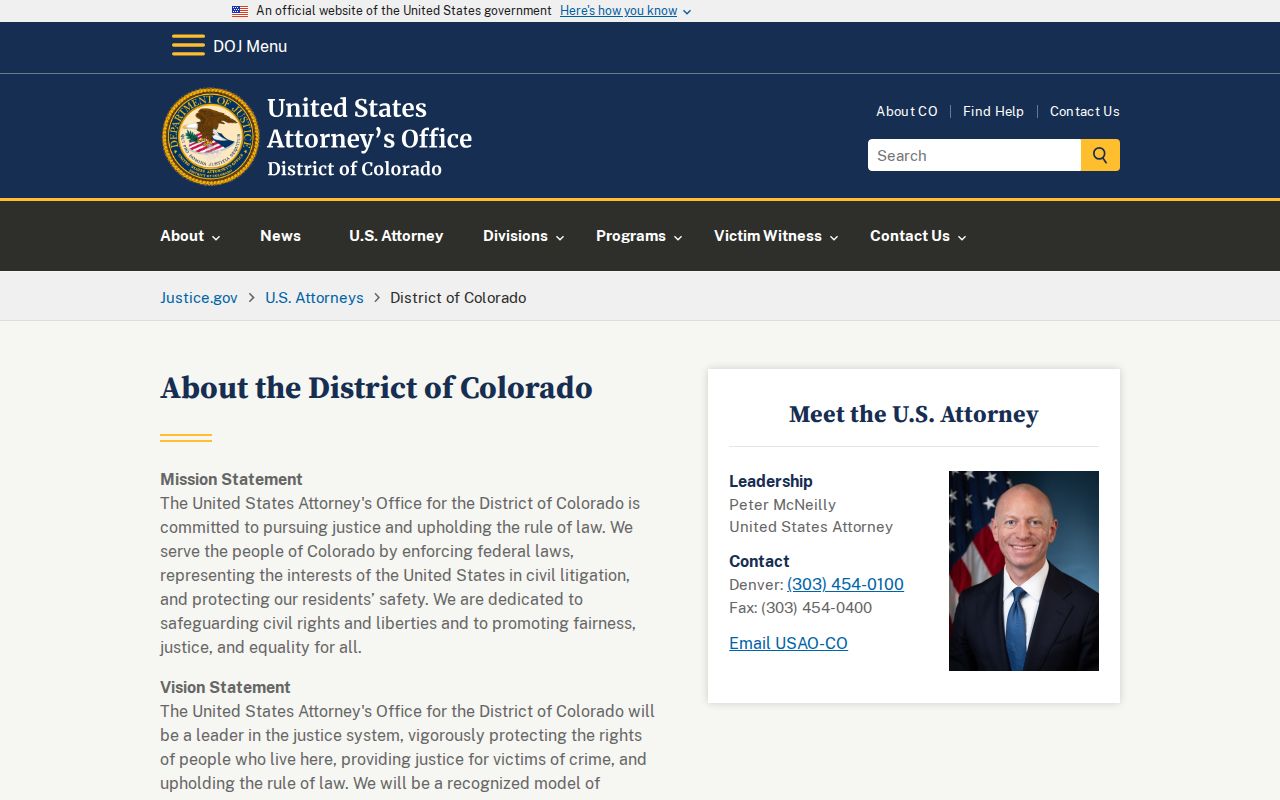
The image is useful context because it separates federal prosecution from local state charges that appear in Kiowa County court records.
Kiowa County Charge Status Terms
Charge status is the key to reading court charges after arrest. A charge filed at the start of the case may not be the charge at the end. Plea talks, evidence review, diversion, deferred judgment, witness issues, or legal motions can change what stays in the file and what counts toward a conviction.
| Status | What It Means |
|---|---|
| Pending | The charge remains open and no final result has been entered. |
| Amended | The prosecutor or court record changed the count, statute, level, or description. |
| Reduced | The filed count moved to a lower offense or lesser severity as part of case resolution. |
| Dismissed | The charge was ended without a conviction on that count. |
| Deferred | The case may be held open under court terms before final judgment, depending on the order. |
| Disposed | The court has entered a final result for the count or case. |
Charges vs Convictions
An arrest and a filed charge do not equal a conviction. A booking charge may reflect what law enforcement believed at arrest. A filed charge reflects what the prosecutor asks the court to process. A conviction requires a guilty plea, a verdict, or another qualifying court outcome. This distinction protects accuracy when reading Kiowa County arrest records and court charges.
| Charge | Conviction | |
|---|---|---|
| Timing | Appears after arrest, summons, or prosecutor filing | Appears after plea, verdict, or final finding |
| Meaning | Allegation or filed count | Legal finding of guilt |
| Can Change | May be amended, reduced, added, or dismissed | Can be appealed, sealed, or affected by later court orders |
| Best Proof | Charging document or docket entry | Certified disposition or sentencing order |
Arrest Records, Jail, and Court Dockets
Kiowa County research found no official public online jail roster, inmate lookup form, current booking list, sheriff app, or app-only warrant and inmate feature. That absence should be treated as a real access fact. A person checking custody status needs to contact the sheriff directly with the full legal name and date of birth if known. The court docket becomes more useful after charges are filed and scheduled.
Booking records, court dockets, CBI history, and DOC offender search answer different questions. A jail record can show current custody. A docket can show hearings and filed charges. CBI can show statewide public criminal-history events. DOC offender search applies to sentenced state-prison custody, not a newly arrested person waiting for first appearance in Kiowa County.
Note: A sheriff booking fact can exist before the formal court charge appears in the public docket.
Statewide Charge and History Lookup
Colorado's official statewide criminal-history route is CBI. The CBI search is name based and may use first name, last name, date of birth, and payment fields. It is useful when a user needs broader Colorado criminal-history information. It should not be used as proof of a specific Kiowa County court disposition when the court can provide the certified case document.
For sex-offender records, the Colorado Bureau of Investigation maintains a separate public registry. For sentenced state prison custody, Colorado DOC offender search is the correct channel. For federal cases, PACER and the District of Colorado federal court systems apply. None of those tools replaces the Kiowa County Combined Court clerk for public court-charge documents in a local state case.
Protection Orders and Charge Context
Some criminal cases include protection orders or no-contact conditions. Civil protection orders may also exist in county court. These orders can affect bond, release, plea terms, and sentence conditions, but protected addresses, victim details, minor information, and sealed filings may be restricted. Court records may show that an order exists without exposing every sensitive fact.
Colorado Judicial protection-order self-help is relevant when arrest records and court charges involve no-contact conditions or related civil protection-order proceedings.
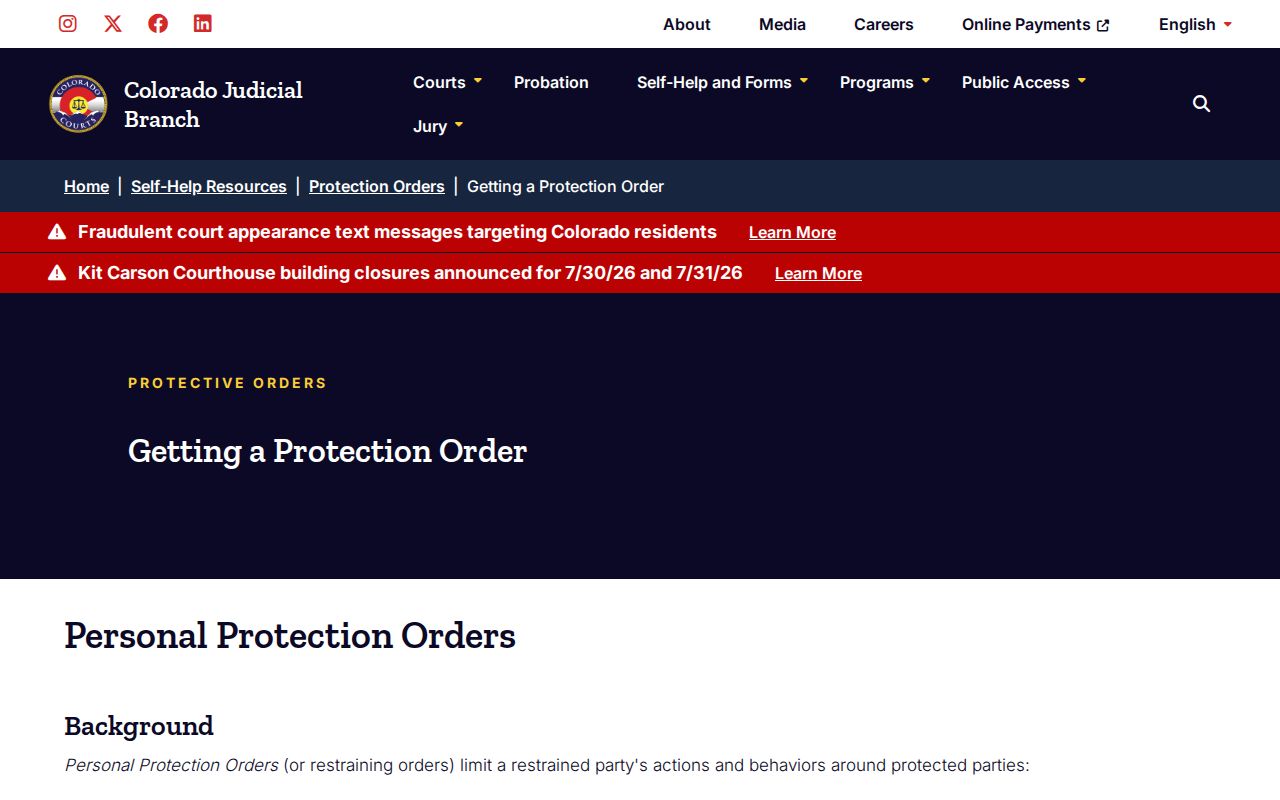
Protection-order records are part of the access picture, but public copies may be redacted to protect victims, children, addresses, and confidential details.
Sealed Arrest Records and Charges
Colorado records can be sealed or, in limited categories, expunged. Sealing hides a record from ordinary public search, though courts and law enforcement may retain limited access. Expungement is narrower and can remove records more fully from public access in eligible categories. Juvenile charges, adoption records, mental health matters, protected victim information, and sealed adult matters may not appear in public lookup tools.
| Sealed | Expunged | |
|---|---|---|
| Public Search | Ordinary public access is blocked or sharply limited | Record may be removed from public access if eligible |
| Government Use | Some court and law-enforcement access may remain | Access depends on the expungement statute and order |
| Typical Path | Petition in the court that handled the case | Confirm statutory eligibility first |
Restricted Kiowa County Charge Records
Public access is strongest for adult court records that are not sealed, but it is not unlimited. Colorado law and court rules restrict juvenile records, sealed records, expunged records, adoption matters, mental health information, protected addresses, victim-sensitive details, and personal identifiers. Active investigative records and unexecuted search warrants may also be withheld.
For a reliable outcome, request a certified disposition or sentencing order from Kiowa County Combined Court after the case is resolved. For live warrant or custody risk, contact the sheriff, court clerk, or an attorney before appearing in person. For municipal ordinance cases, check the municipal court that issued the summons or ticket if the matter does not appear through the state county-court docket.